
Our mission has always been to celebrate the transformative power of light. For over a decade, we’ve brought world-class lighting solutions to some of the most prestigious artworks and curatorial projects around the world. But our commitment goes beyond illumination—through our not-for-profit exhibition space, TM Gallery, we’ve cultivated a dynamic programme of contemporary art exhibitions, talks, and events. This space serves as a vital platform for mid-career artists, presented in collaboration with leading galleries and curators.
Our new Artist Spotlight series offers a glimpse into the minds of these artists—sharing the ideas, processes, and inspirations that shape their work.
“Colour is everything”, says Ella Bril in connection to her new solo exhibition opening at TM Gallery next month. We agree.
This month, we are excited to welcome Ella Bril to the TM Gallery for a new solo exhibition presented by MTArt Agency. Opening on 16 October 2025, the exhibition features a series of evocative oil paintings that reflect on the meaning of motherhood and the quiet power of care, connection, and emotional presence during uncertain times.We’re especially excited by how Ella uses colour, not just visually, but as an emotional language. She explores how tones interact and shift perception, much like how we use light to reveal colour in its truest form, and to enhance an artwork’s ability to move and connect with the viewer.Below, in the next in our Artist Spotlight series of interviews, we offer a glimpse into the mind of Ella Bril – sharing the ideas, processes, and inspirations that shape her work.
With thanks to our programme curator, Hannah Payne, for this interview.
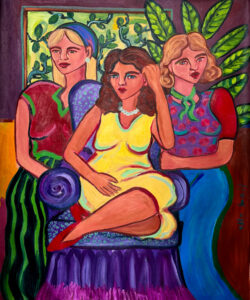
Ella Bril |‘Motherhood; Luminous Origins‘ opens on 16 October and runs until 12 December 2025 at TM Gallery, TM Lighting, 7 Cubitt Street, London WC1X 0LN.
1. You’ve recently become a mother and this new body of work is deeply rooted in that experience. How has becoming a mother shaped your perspective – both personally and artistically – and how are you navigating your dual roles as an artist and a mother?
Becoming a mother has changed everything. I feel like a totally different person. From the moment I became pregnant with Polly, and I fully realised that I had a whole human growing inside me, I felt extremely powerful and fulfilled, probably for the first time ever. The experience changed my perspective. My respect and admiration for a woman’s capability – both physically and emotionally – grew immensely. I started to see mothers everywhere I went, and somehow I felt connected. Naturally I wanted to hold on to these new feelings and insights and use it in my new work. I don’t really think that nine months’ pregnancy prepares you for what comes next: A baby. Vulnerable, tiny, almost entirely dependent upon me.I use painting to manage my thoughts and emotions. When I had the baby I had to focus on the baby and put down the paint brush. This is when my thoughts and emotions started to haunt me. When this happened, I had to go back to the studio as soon as I could. Even though I had promised myself that I would take things slowly, I ended up painting a commissioned piece of six metres only a few weeks after birth. It was a necessity! Painting is a must, and I’m lucky to have help around for Polly.
2. Much of this series seems to honour the quiet emotional effort that often goes unseen but is deeply felt, particularly in the works Breastfeeding by Moonlight and Safe with Me. How do you approach translating something so intangible into the visual language of painting?
I love that this feeling is coming across. This is exactly what it’s about. I briefly mentioned that I would go all in when it comes to putting my emotions and feelings into painting. It’s my way of coping. I just have to do it. And I think it’s the most beautiful thing when somehow it is transferred onto the viewer through my work. Sometimes this is intentional, other times this is unintentional and more indirect. Sometimes I am surprised about the story or the feeling when someone connects to a certain painting, and I’m always interested and intrigued by other perspectives. This is what painting is about, right? To feel something, whether those feelings are good or bad. That doesn’t matter in art.
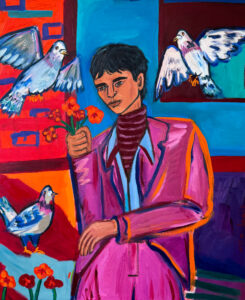
3. One of the new works is titled Becoming a Father. In this painting, the central figure is holding flowers, while birds appear around and framing the figure. Can you tell us more about this piece – and what the symbolic meaning of these elements might be – in the context of an exhibition exploring motherhood, care, and emotional presence?
Yes, that’s correct, Becoming a Father is about the other half. The first time Polly was handed over to her father, I saw such a huge a change in his eyes. It was very subtle yet very noticeable. The look that meant ‘I will always care for you’. And that’s the word this painting is about: Care. The father figure holding the flowers, as a symbol of true admiration and love. rushing to her through the city, meeting his child for the very first time. White pigeons rise into the air, circling around the figure—symbols of peace in a world that feels so unstable. Like the pigeons themselves, peace is always present yet almost invisible, so common that people take it for granted. But we are lucky, you know, luckier than we often realise. I think about this a lot. And I use it in a symbolic way in my paintings. It’s also present in Safe with Me where a black crow is resting on the mother’s head. It symbolises darkness, dangers and bad intentions. They are always around. And it’s our job as humans to protect the children.
4. This is your first solo exhibition in London – congratulations! It’s a big moment, taking place during London’s Frieze week. As a Dutch artist based in Amsterdam, how does it feel to be showing in the UK for the first time, and what are your thoughts on bringing your work into dialogue with London’s vibrant art scene and cultural landscape?
Yes, thank you so much! I’m really excited about this opportunity, the art scene in London feels so much more vibrant and present than in Amsterdam. I’m especially curious to see how people will respond. I have actually sold several pieces to London-based collectors already, so I’m eager to see where this journey leads with my first physical solo exhibition.
5. Colour feels like a heartbeat in your work – so bold and emotionally charged. How do you approach colour when beginning a painting? Do you think about emotion first, or does it evolve instinctively as you work?
It definitely evolves throughout the painting process. I often change my colours, even when a piece feels ‘finished.’ After a few days, I might look at it again and realise something feels wrong. When I adjust it, the painting transforms into an entirely new story, and I love playing with that. For me, colour is everything; it carries the narrative. Every shade evokes a certain feeling, and sometimes it’s the unconventional, even controversial, colour combinations that make the work interesting.
6. Tell us about your inspirations with regards to the use of colour in your artwork?
The way that figures are painted so freely in German Expressionism have always inspired me, along with their use of colour; Ernst Ludwig Kirchner’s painting Czardas Dancers, for example. The use of color is just sublime. When I was young, one of the first artist’s to inspire me was Van Gogh. I remember feeling so much emotion looking at his paintings and I became super invested in his story. Same goes for some other big names like Frida Kahlo, Picasso, Matisse, Chagall, Marlene Dumas, David Hockney. All of them were very big influences, maybe quite obvious ones but I feel like I have to name them since they are huge heros of mine and they were able to change so much in the art scene. They gave artists In today’s world the true freedom to create.
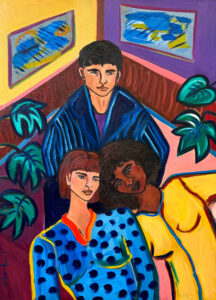
7. One of the works in this series is titled Millennials, depicting three figures closely positioned in a vibrant interior space. Could you tell us more about the context behind this painting – does it draw on personal experience or broader observations of contemporary life, and how might it connect to your reflections on motherhood and emotional connection in this body of work?
This piece might feel a bit like the odd one out. But Millennials connects on a broader level to my generation, many of us now becoming parents or already raising children. We’ve been through so many challenges, prejudices, societal struggles, the overwhelming presence of technology. But somehow, we still find each other and hold onto true connections. That sense of closeness, strength and resilience is very similar to my view on motherhood.
8. Your works are large in scale, and they will be shown at TM Gallery – a space with considerable height and specialist art lighting, elements that can amplify their luminosity and presence. How are you imagining the works might inhabit this environment, and what are you most looking forward to seeing or experiencing when they’re finally shown in situ?
Oh, I can’t wait to see them in the space! I feel like it’s going to elevate the paintings to a whole new level. It can be really tricky to photograph my work in my atelier. It is so hard to capture the intensity of my artworks on screen so the lighting and space will be key to transforming this viewing experience. I think the TM Gallery space and the expertise that comes with it, will blow my mind and hopefully everyone else’s.
9. There are often elements of nature and dreamlike abstraction surrounding your figures – birds, plants, flowing forms. What role do these motifs play in framing or intensifying the human presence at the centre of your paintings?
Besides the colours, these natural elements are also really distinctive for my work. Sometimes I use it to symbolise a thought or a certain perspective. Other times I use it because I feel that it adds to the mystery and narrative of the figures I paint. Besides this, I’m always really drawn by nature and natural elements, and I really believe we become better humans when we’re surrounded by nature. This is something I also struggle with daily, living in a crowded city like Amsterdam. It can easily overwhelm me, but it’s also mandatory to live here for my boyfriend’s career. But if it were only me, I would probably live somewhere quiet in nature, where you can see loads of stars at nighttime, and waking up to the sound of birds. Maybe someday, we’ll see.