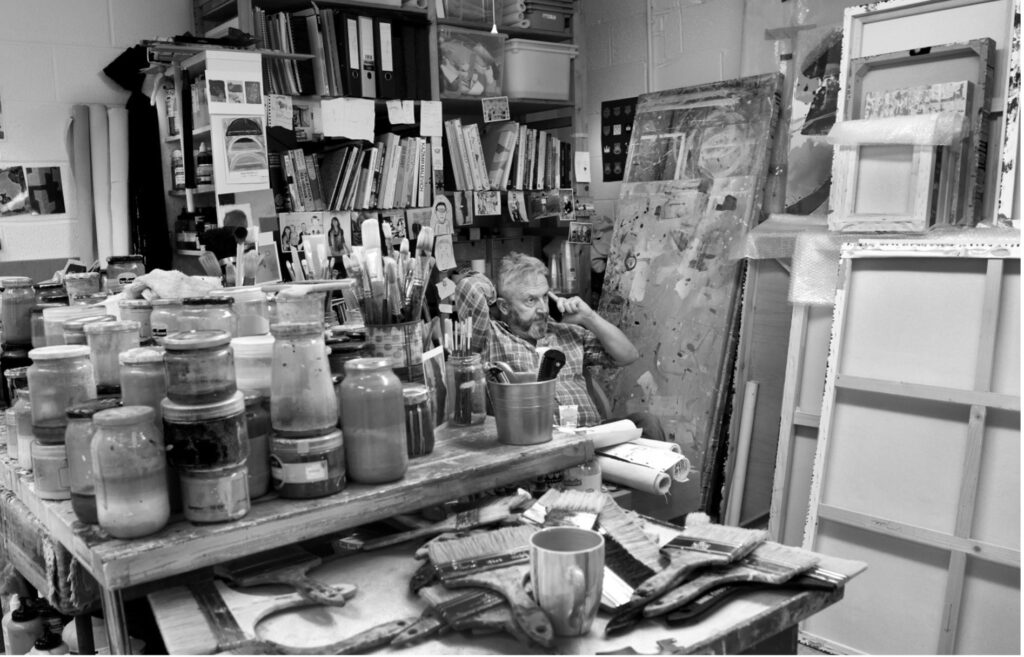
For Stewart Geddes, painting is an exploration of light, colour, movement and perception.
His work invites the viewer to look closely, revealing shifting relationships between colour, form and space. Light plays an important role in this experience, influencing how the paintings are encountered and allowing their subtle changes in tone, texture and atmosphere to emerge.
For this Artist Spotlight, we had the privilege of speaking with Stewart Geddes about his approach to painting, the ideas behind his work, and the role of light in shaping the way we experience his paintings.
Stewart reflects on the idea of kairos – the recognition of the right or opportune moment – and how this concept resonates with his approach to painting. We explore what his paintings might offer the viewer and the relationship between the work, its surroundings and the changing experience of light.
Interview by TM Lighting
1. The idea of Kairos – the recognition of the right or opportune moment – seems to resonate deeply with the way you paint. Beyond the process itself, what do you think these paintings might offer a viewer? Is there something you hope they discover or recognise when they spend time with the work?
The choice of ‘Kairos’ – the recognition of the right or opportune moment – as the exhibition title highlights a key aspect of the decision-making environment from which my paintings emerge.
One of the things paintings don’t record are the hours of inaction: time spent simply looking and thinking and running through in one’s mind the implications of this or that possible action. With an improvised, painterly form of abstract painting, where there is no set target, and resolution is ’found’ through engaging with the process, there are many permutations to consider – judgements of colour choice, saturation, paint viscosity, brush size, weight of touch, speed of gesture, etc. – are especially critical. Then the opportune moment arrives, and the action takes place…
I don’t wish to dictate any specific experience the viewer may or may not have of my painting or lead the encounter. It’s for that reason that each painting has a name, which in effect is without meaning. I’d like the viewer to have an unencumbered experience of my works’ formal organisation. I’m especially curious about how the formal condition of a work can act as direct communication between consciousnesses. Even as a young boy, I remember being fascinated by the surface and inferred depth of Monet’s late nympheas paintings.
2. Can you take us into the process of making a painting; the moments when you feel inspired or recognise that something has suddenly become “right”?
I begin with an inert blank surface, a rectangle or square, with two parallel sides, which I rhythmically activate by adding paint.
I start with a colour proposition, a cluster of colours or palette, which I half playfully, half thoughtfully add to the surface in two ways: a meandering linear gesture, alongside puddled, amorphous shapes. After the first draft there is a pause, during which I reflect on what has occurred and consider the next phase of action. Somewhere down the line resolution may be ‘found’.
Considering when something is resolved or ‘right’ is more often than not a hesitant decision. Mostly, it’s a gradual process of realisation. In many ways the paintings dictate to me rather than the other way round, and I have to carefully ‘listen’ to them. They reveal to me what I have been preoccupied with.
As previously suggested, I start with a proposition, which I then test. I don’t start with an object or idea which I drive the painting toward. Having said that I recognise I don’t operate in a vacuum, and after-the-event I recognise things beyond the studio have entered the work. Quite often these are landscape elements.
I originally studied fine art in Bristol, and after an extended period in London, I returned there for teaching reasons. Bristol is a city infiltrated by nature. From its centre, you can see hills, fields and trees. Significantly, its river – the river Avon – has the second highest tidal range in the world, and my daily journey to the studio involves dropping down into the Avon Gorge. Sometimes the river is so high you think it might inundate the city, whereas a few hours later it’s more like a stream nestled amongst great ranges of delicious grey mud (Richard Long has used this unctuous material for his wall paintings). Pigment is primarily made from mud suspended in a medium, and I think this daily encounter has informed my return to a painterly form of abstraction.
4. You often work on paintings in clusters, allowing ideas, gestures and possibilities to move between works. What does working across a body of paintings allow you to discover that might not emerge from making a single work at a time?
I typically work on around 20 paintings at any given time. Some remain unworked for long periods, whilst others are worked from one day to the next. Often, issues addressed in one painting help advance others.
It’s a bit clunky to describe it as such, but my painting sometimes feels like the resolution of a self-inflicted conundrum. Because I’m the involved party, judging where to go next can be difficult. Consequently, I have to wait and displace my activity in a related field – most usually another painting – and trust that through that, ideas elsewhere will emerge. It’s a version of the old T.S. Eliot adage, “Distracted from distraction by distraction.”
5. Kairos is being presented at TM Gallery, a space founded by TM Lighting. How does the context in which a painting is encountered affect your and the viewer’s relationship with the work – and what do you hope happens when these paintings leave the studio and enter a space like this?
‘Publishing’ my work outside the familiarity of the studio helps me see things in a new way. And placing the work in the public domain sharpens one’s criticality. Paintings are personal things, so you do have a sense of vulnerability.
You move from the studio condition, which is about communicating with yourself, to the condition of the gallery, which is about communicating with others. For me this is a completion of the process. It’s a learning experience too, where intention and reception – which are not always the same — are laid bare.
Specifically with the TM Gallery and its founding by TM Lighting, I’m looking forward to their expertise in lighting fine art enhancing the experience of my paintings. Colour interaction and colour as communication is at the core of my practice, so light conditions are essential. I’m also very grateful to them for giving my work this platform. Having lived and worked in London for many years, it’s great to bring the work back here.
A particular aspect of the TM Gallery is its mixture of a discrete gallery space, alongside an administrative working environment. It will be interesting placing the paintings across the two environments whilst maintaining cohesion of the whole experience.
6. Does this body of work have a significant connection with music? You have painted works for album covers before due to the inspiration that music has in your life. Can you tell us more about this?
I subscribe to Kandinsky’s thesis of pursuing a visual art that aspires to the condition of music. That is, an art that deploys its elements – colour, line, form – to evoke direct intellectual, emotional and metaphysical response, rather than through the depiction of real-world objects.
This ‘musical’ quality in my work led Philip Selway of Radiohead, who had previously known my painting, to suggest we trial a collaboration. Philip was in the process of writing his solo album ‘Strange Dance’ and the subsequent ‘Live at Evolution Studios’. As the project developed, we had a form of dialogue between our different creative languages. It took place during lockdown, when communication was not straightforward. This made the experience especially nourishing.
The outcomes – Philip’s songs and my paintings, which were ultimately used for the various album covers – sit alongside each other, simultaneously autonomous and yet interlinked.
Finally, it’s important I mention my appreciation for the support and working relationship with Close Gallery Director and curator of this show, Freeny Yianni. Her intelligence, humour, enthusiasm and generosity have been pivotal elements in my work’s development, and I’m enormously grateful to her. She’s a brilliant support to artists and their art and great to hang out with!