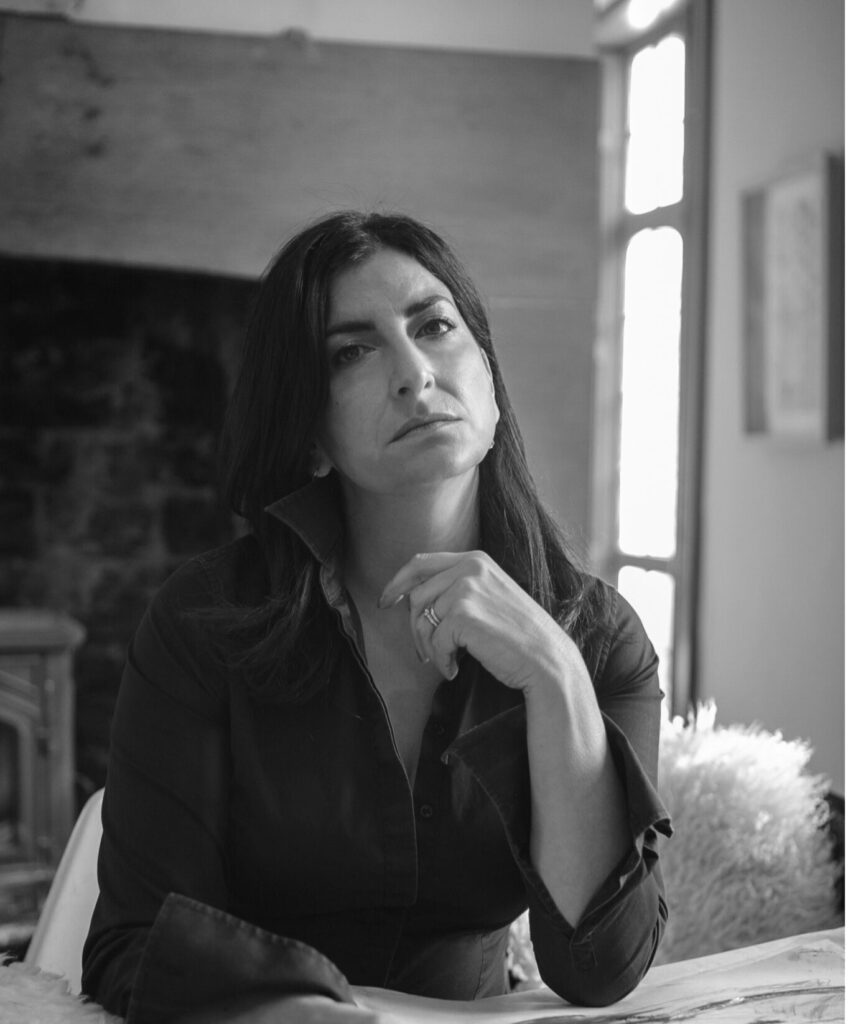
We are delighted to be working with Freeny Yianni, whose thoughtful curatorial perspective has been instrumental in shaping the exhibition and bringing its ideas into focus.
As a curator, Freeny brings a considered approach to the relationship between artists, their work and the spaces in which audiences encounter them. Her perspective offers a deeper understanding of the ideas and intentions behind the exhibition while creating space for viewers to engage with the work in their own way.
For this Curator Spotlight, we spoke with Freeny about her approach to curating, her perspective on the exhibition and the ways in which art can be experienced through its relationship with space, atmosphere and light.
We were particularly interested to hear Freeny reflect on the role of lighting within the exhibition and how carefully considered illumination can influence the way a work is encountered, drawing out detail, texture and atmosphere without competing with the art itself.
KAIROS | Curated by Freeny Yianni, Founder and Creative Director of CLOSE Gallery | Co-Chair of Charity Somerset Arts Week (SAW).
In conversation with TM Lighting
1. What was it about Stewart Geddes’ practice and particularly this recent body of work that made you want to bring these paintings together for Kairos?
I have known Stewart and his work for some time, and our relationship has developed through a genuine familiarity with one another’s working practices. As the founder of CLOSE Gallery and as Stewart’s art dealer, I have watched his practice develop very closely, and I think there is something particularly important happening in these paintings now.
Kairos came out of a feeling that Stewart had arrived somewhere. I don’t mean arrived at a destination, because his paintings are still very much alive, exploratory and open-ended, but there is a sense that the work has reached a point of recognition. The paintings seem to understand themselves. There is a confidence and clarity that comes from many years of looking, questioning, making and, importantly, allowing the painting to tell him where it needs to go.
The word Kairos describes the right or opportune moment, the title came from the artist as he felt that was very appropriate. For me, these paintings represent a kind of coming home a sense of arrival after a long journey. Stewart has been on an extraordinary journey as a painter, educator, writer, curator and advocate for painting, and I feel that all those experiences have somehow been distilled into the work we are seeing now.
Stewart is also a hugely significant figure within art education. His understanding of art history is wide and far-reaching, and his career has moved between making, teaching, writing, curating and institutional life. He has spent decades immersed in art and in the education of artists, and that depth of knowledge inevitably informs the paintings.
But there came a point when Stewart made the very conscious decision to step away from the teaching side of his life and give himself completely to his own practice. For the past few years he has been wholly committed to painting. I think that commitment matters enormously. These paintings are being made by someone who has chosen to give himself entirely to being an artist.
There is therefore a sense of a life coming together in the work. It feels like a moment of fruition — perhaps even a kind of heyday. Not the end of something, but a period in which the experience of a lifetime is suddenly available to the painting.
And there is another aspect of Stewart that I think is very important. He has never wanted art to become something that belongs only to a particular social or economic group. He wants the work to be accessible — intellectually, emotionally and financially. He believes that people should be able to live with art, encounter it without intimidation and, where they wish to, collect it at a reasonable and pragmatic price.
That is very close to my own philosophy at CLOSE. Stewart walks with the common man. He has a very strong belief in equality and in the dignity of every individual, and I think that generosity is present in the paintings themselves. They may have considerable intellectual and art-historical depth, but they don’t demand that you arrive with a particular education in order to meet them.
2. The title Kairos speaks to the moment being opportune, necessary or suddenly right. How did this idea shape your reading of the work and, ultimately, the way you approached the exhibition?
For me, Kairos is about recognising the moment when something becomes right.
That is very much how I see Stewart’s paintings. His process involves improvisation, but it isn’t improvisation without thought. There is a constant negotiation between intuition and deliberation between making a gesture and then stepping back, between allowing something to happen and knowing when to intervene.
The paintings develop through these moments of decision. Stewart is responding constantly to what is in front of him, and there is a beautiful tension between control and freedom.
That is why Kairos felt so natural as a title. It isn’t simply about timing; it is about recognising the significance of a particular moment.
I also think it speaks to where Stewart is in his life; he has been incredibly generous in passing knowledge on to generations of artists. Now he has deliberately turned that attention entirely towards his own painting. There is something very moving about that decision. It is an act of commitment.
The title therefore became both a description of the paintings and a description of the