Our mission has always been to celebrate the transformative power of light. For over a decade, we’ve brought world-class lighting solutions to some of the most prestigious artworks and curatorial projects around the world. But our commitment goes beyond illumination—through our not-for-profit exhibition space, TM Gallery, we’ve cultivated a dynamic programme of contemporary art exhibitions, talks, and events. This space serves as a vital platform for mid-career artists, presented in collaboration with leading galleries and curators.
Our Artist Spotlight series offers a glimpse into the minds of these artists—sharing the ideas, processes, and inspirations that shape their work.
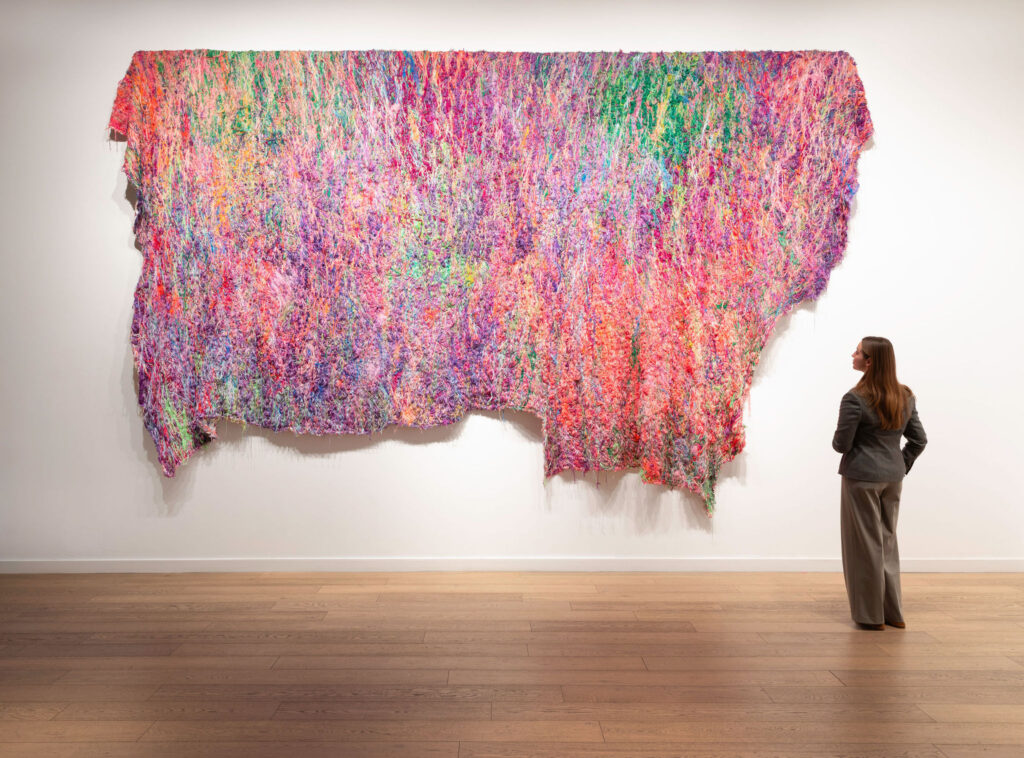
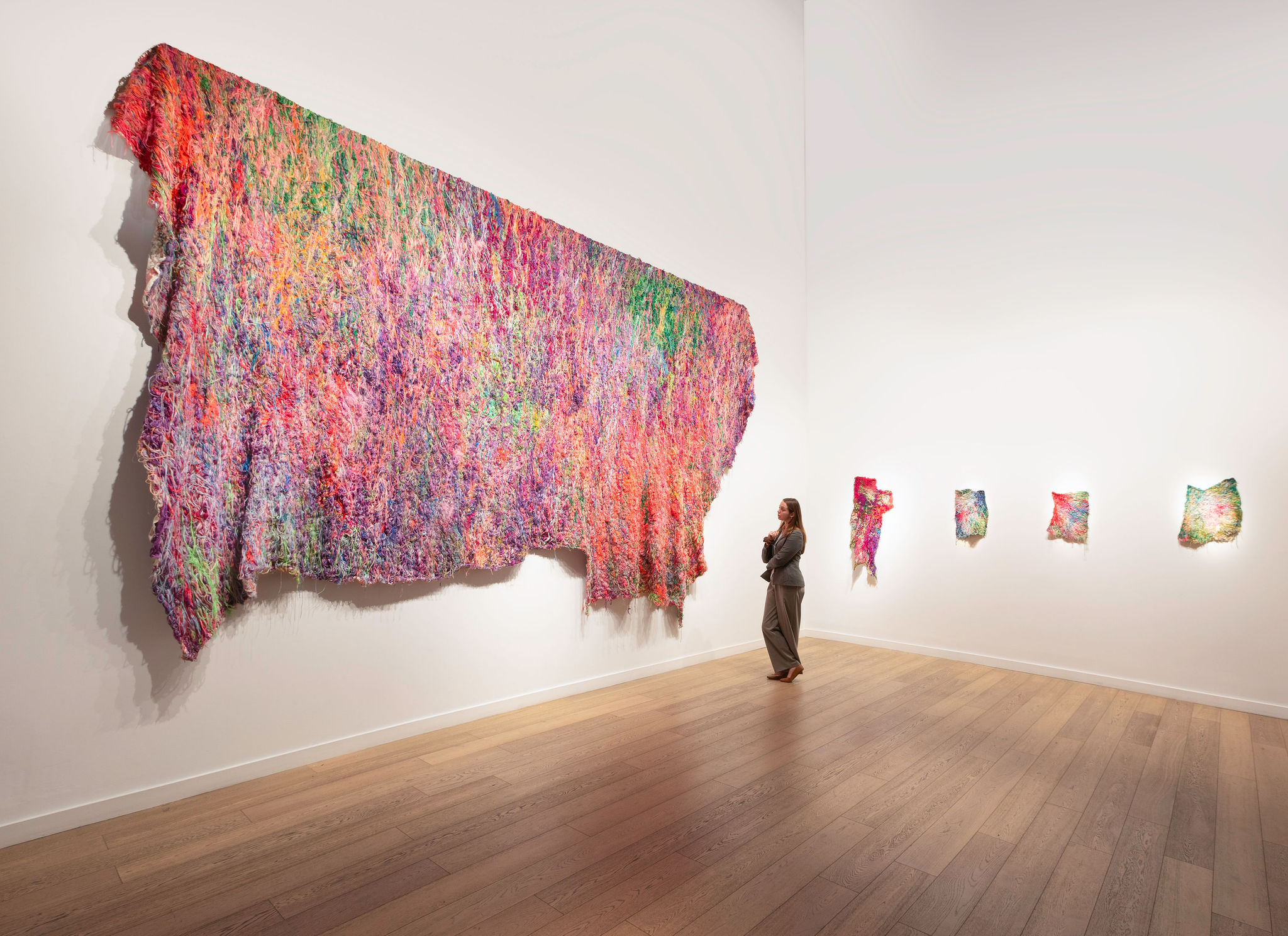
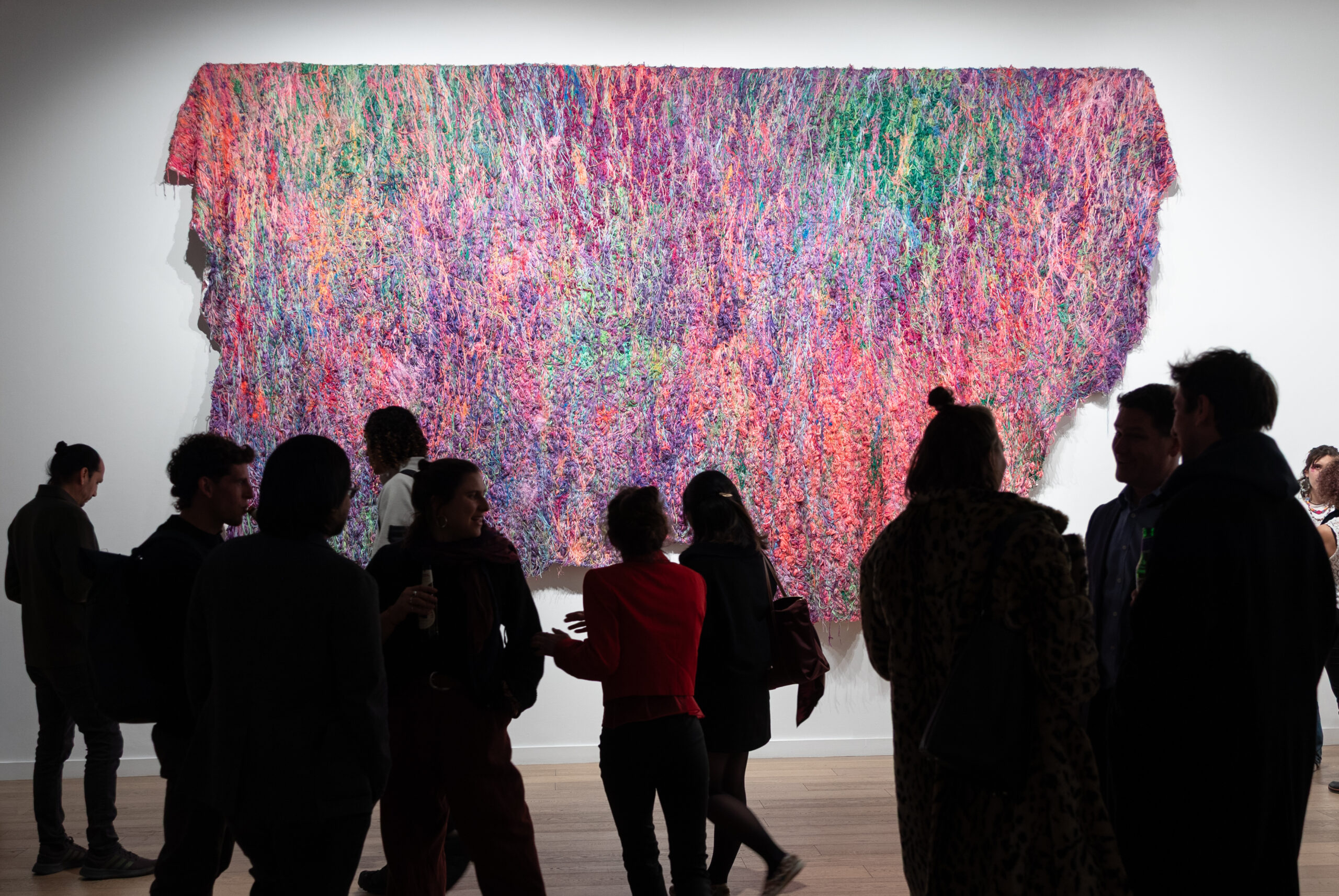
In advance of her solo exhibition Chromatic Solace at TM Gallery, we speak with Chilean-born, Oxford-based textile artist about the evolution of her practice, her distinctive process of “painting” with thread, and the materials that underpin her work. The conversation explores her use of repurposed domestic textiles, the development of a new six-metre installation created following her residency at Philadelphia’s Magic Gardens, and the ways colour, place and scale shape her approach to making.
With thanks to Hannah Payne for conducting the interview.
Carmen Mardonez | ‘Chromatic Solace’ runs until 26 June 2026
at TM Gallery, 7 Cubitt Street, London WC1X 0LN.
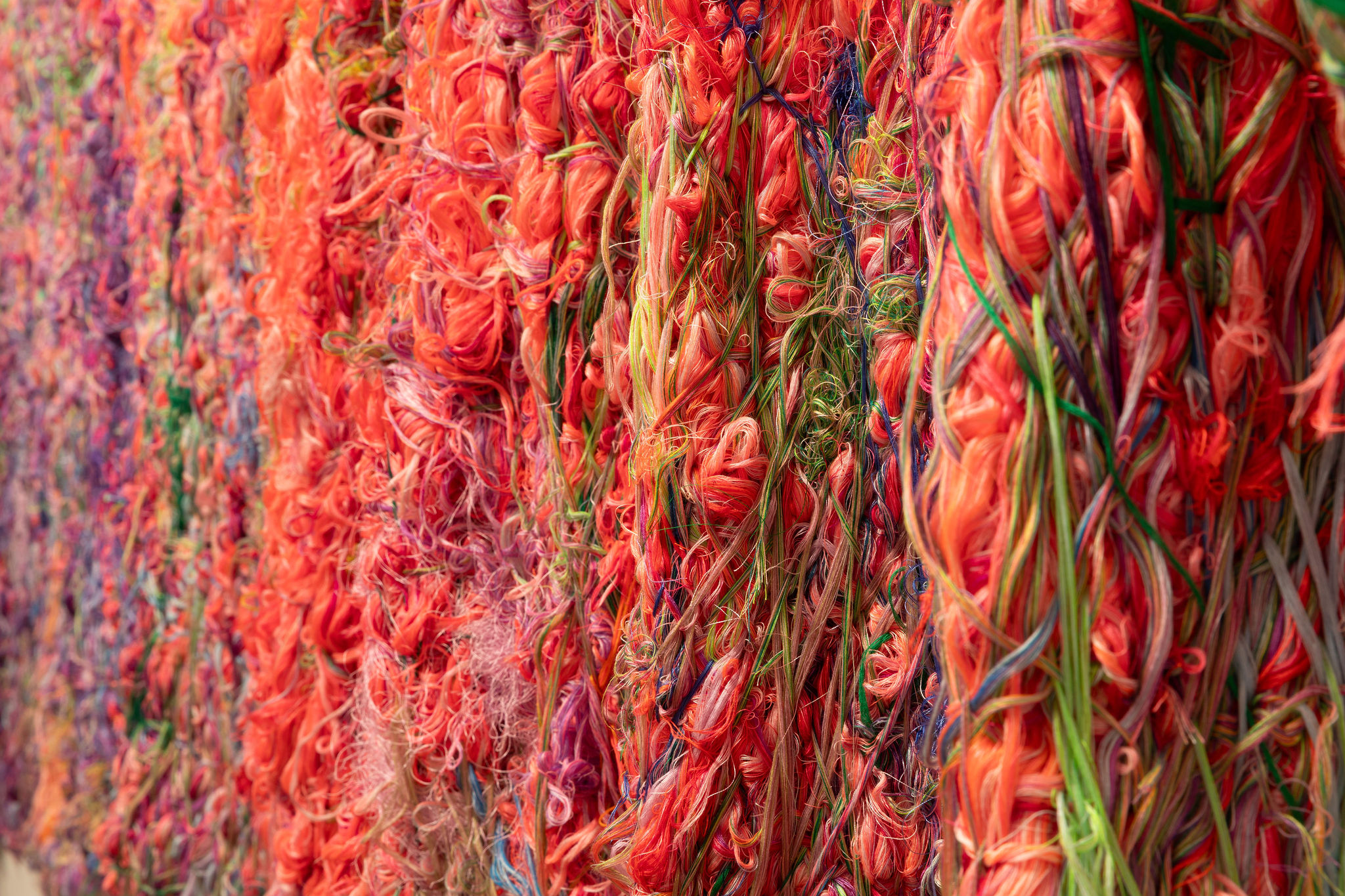
Could you tell us about the origins of your practice and what first led you to work with embroidery and fibre as your primary language? Your process has a distinctive, painterly quality – combining multiple-coloured threads into thicker strands and embroidering freehand without following a fixed pattern. How did this method develop?
I started exploring freestyle embroidery in 2015–16, inspired by the work of the Chilean artist Victor Espinoza. At the time, I was working a full-time job and was writing my master’s thesis in community psychology, so the beginning of my practice was quite slow and exploratory, and just for myself. I used threads rather than painting simply because I was living in an apartment, and I needed a medium that would allow me to keep it tidy, work cleanly (I am a mess with paint!), and without using much space. I thought threads and fabric were perfect for that.
When we moved to Los Angeles, in 2017, with my partner and our newborn, I decided I’d embrace embroidery as my new “occupation”, alongside motherhood. Once again, the medium was very suitable, since I could work on it while nursing or cooking, and then in the playground, a park, or the beach. Since then, my art, my child, and my migration have been braided together, with their happiness, difficulties, and everything in between. But even during the most difficult times, art has brought me so much joy and pleasure, that it is really my most important form of self-care.
I’d say the two main transformations of my work over these years are related to color and scale. At the beginning I searched for inspiration in natural landscapes and pictures. I embroidered sunsets and northern lights, in an abstract but still somewhat figurative way. Later, I used these references only to pick my colour palettes, but now (probably since Pinky Promise, a largescale piece made between 2022-25) I work without any clear reference, just combining colours at will and experimenting with that. Regarding scale, I progressively abandoned the hoop and started going bigger and wilder. During Covid, I ran out of canvas and started collecting bedsheets from my neighbors and directly embroidered them on the walls of my living room. I loved the freedom that this new scale gave me, and started dreaming of even bigger, surrounding pieces and installations, a project I’m still working on. So, the scale itself pushed me away from figurative references, into a more intuitive approach.
A defining aspect of your work is the use of discarded domestic textiles – particularly bed sheets, which become the ground for your freehand embroidery. How did this approach emerge, and what does it mean to transform materials that already carry traces of everyday life and community histories?
In 2019, I started embroidering pieces the size of bed sheets (you can see them in the earlier Bed Sheets Series). During the Covid lockdown, when I ran out of my family’s old linens, I began asking neighbours in “buy nothing” Facebook groups if they would donate the bed sheets that were ready to throw away. At the same time, I also started exploring three-dimensional work using discarded pillows.
I think that, due to the sense of isolation during Covid, made the reaction of people when I asked for linen—so many people willing to donate—, and the small moments of contact when I collected them, very meaningful. Sometimes the bags were left on an empty porch with my name on them; but other times people delivered them so I could briefly meet them.
People are very used to touching fabric all the time, but it is not the same to touch a brand-new fabric from the store than to touch linen that has already been used in someone’s home. Even when it is impeccable —and I don’t really mind if it has stains, because I will cover them with threads anyway—, you can feel something there: the wear, the smells, the traces of time. You can feel the presence of people. So, when I am embroidering, when I am creating, I try to honour that trust, the opportunity of being part of such an intimate space.
Last year, I lost three very significant people in my life. In each case, I was not there when they died, nor I could attend their funerals. So, I asked my family and friends to save one of their old bed sheets for me. I know that, when the time feels right, I will return to these textiles and create something special from them. This exercise helps me to grieve, connect, and process; such is the power of a textile!
Chromatic Solace includes the debut of a major six-metre textile installation developed following your residency and grant from Philadelphia’s Magic Gardens. The work will be unveiled first at TM Gallery before travelling to the museum in 2027 – a site shaped by the remarkable legacy of its founder Isaiah Zagar. What has it meant for you to realise this work through that support, and how do you think about presenting it within a museum context connected to such a distinctive artistic vision?
This opportunity has truly been a dream. Thanks to the generous support of the PEW Center for Arts & Heritage and Philadelphia’s Magic Gardens, I am funded for a year, which allows me to focus on my art full time. What else could one wish for?
Chromatic Solace is the first piece I completed for my upcoming show in Philadelphia. I am just starting to work on the rest of the exhibition. As soon as I finish the installation at TM, I will return to my studio to create new pieces and experiment with some new ideas I’ve been considering.
Importantly, I want this body of work to be in a genuine dialogue with the late Isaiah Zagar’s creative practice. Getting to know him and Julia Zagar in person, a year ago, has been one of the most beautiful gifts that art has given me. I feel strongly inspired and challenged by their creativity and worldbuilding energy.
Both Isaiah’s and my own work use very strong colours, so it will be a challenge to make them coexist. The encounter will happen in a very “loaded” space, rooms covered with mosaic from floor to ceiling. But I love challenges, and I love making art, so I am incredibly excited about the opportunity.
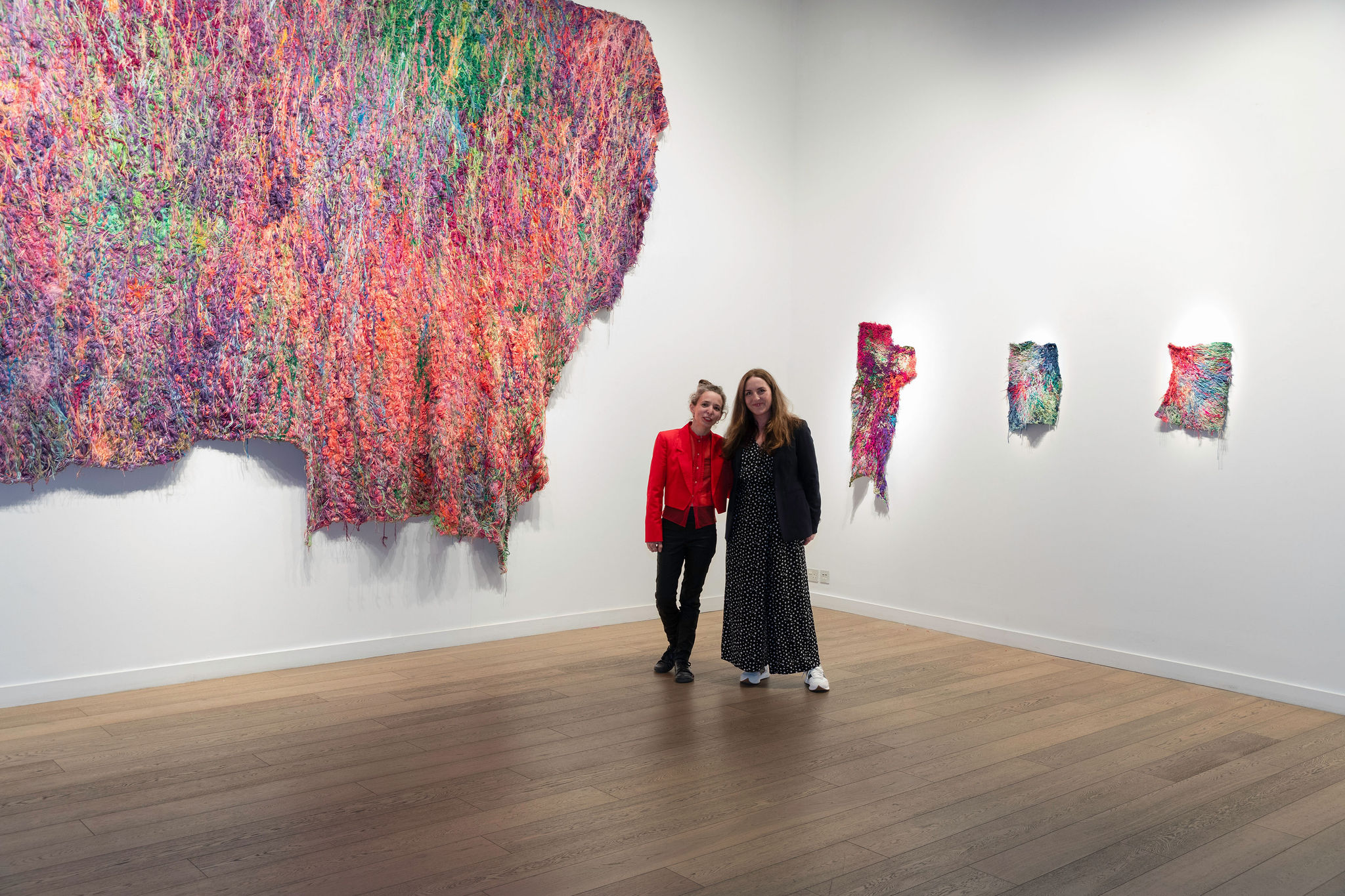
This new installation – and title piece for the exhibition – represents one of your most ambitious works to date. How does working at this scale change your relationship with the materials and the act of stitching – both physically in the studio and conceptually in how the work occupies space?
I love working on an oversized scale. It is exciting to anticipate the final result, which is always a surprise, even to me, until the work is installed in the exhibition space. In my studio, I do not have a wall that is long or tall enough to see the entire piece, so it is always a guessing work, and it could be quite nerve-wrecking at times.
Working on such a large scale with a needle is also physically very demanding. People sometimes compare my work to painting, and I guess the final impression from my embroideries is somewhat pictorial. The “painting” aspect comes from how I prepare my bundles of threads. Before and during the months of embroidery, I would say I spend at least a couple of weeks simply preparing the threads and mixing the colours. I do not make sketches. I decide on an initial colour palette and then begin embroidering. My creative process is entirely intuitive.
Rather than painting with a brush, making these embroideries is closer to using colouring pens on a whole wall. A needle is as thin as a pencil tip, so it takes countless hours before any visible change appears on the canvas. The needle is very sharp, and stitching affects my arms and whole body. I usually work standing for six to eight hours at a time. It requires a lot of mental endurance.
A piece of this size demands complete trust in yourself. You don’t doubt. You keep showing up. You keep going—until it is done.
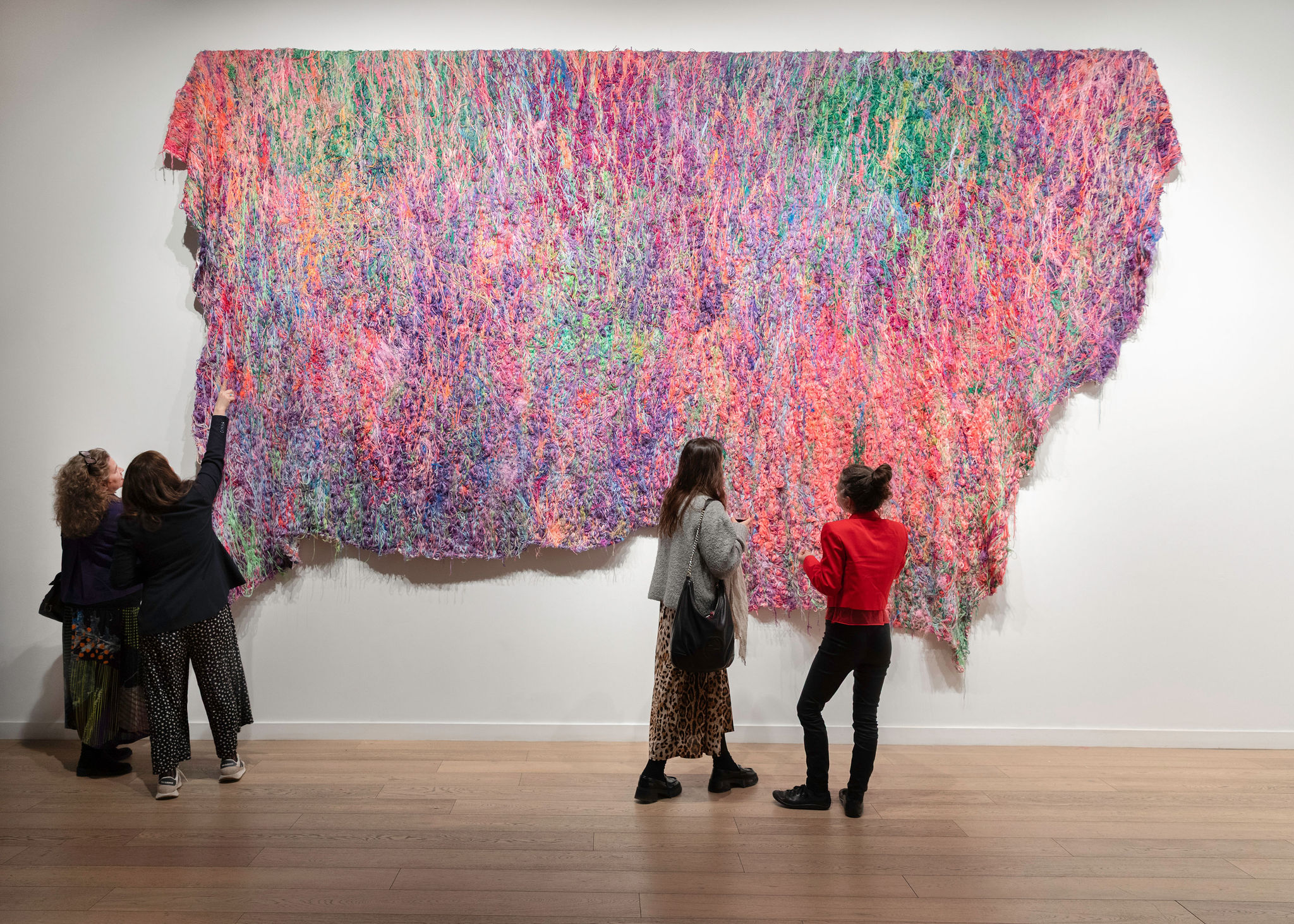
Colour plays a central role in your practice, often reflecting the places you have lived and worked – from the neon pink sunsets of Los Angeles to the cooler greens and blues of Oxford. The new installation in Chromatic Solace introduces a more expansive, multicoloured palette. How do place and light influence your approach to colour, and what has shaped this new chromatic direction?
I can’t help it, I love colours. I really enjoy observing them in nature in great detail: the transitions, the contrasts, the textures. In Los Angeles, it was the sunsets and the ocean. Here, it is the greens I see when I walk my dog, the moss, the flowers in the beautiful spring.
When we moved from LA to Oxford almost three years ago, I thought the colours in my work would change because the surrounding landscape is so different. But they didn’t change very much. Then I realised that I use bright colours not necessarily because I saw them in LA, but because I need them.
My heart needs these colours, their warmth and energy.
The biggest difference when moving countries was actually the light. At first, I really missed the sun, and my mental health suffered a lot because of that. But once I could adjust and return to my work, I found myself coming back to similar palettes. I guess I draw as much inspiration from the landscape outside as from my colours inside.
Looking ahead, what does success mean to you as an artist — and what feels important for the next chapter of your practice?
For me, success means being able to create and share my work with people around the world. So, right now, I feel pretty successful, since as I mentioned I’m being generously supported by the PEW Center and PMG, and I’m collaborating with Hannah Payne Art gallery and TM Lighting to show my work here in London.
It’s overwhelming to think that, only seven years ago, I was having my first group exhibition in Los Angeles, and that I arrived in the UK less than three years ago. Now I am having a solo exhibition in London and preparing a two-venue solo in Philadelphia for 2027.
Looking ahead, I would love to keep dreaming, to set ambitious goals for myself, and at the same time to remember celebrating every step along the way.
Photo credit: David Owens Photo